We're Partnering With Aide to Put Governed AI Agents in Front of Members
The GCC is partnering with Aide to deploy governed AI agents at Canadian credit unions. What the partnership is, how an engagement runs, and which member requests AI should and should not touch.

Nelson Lee
Founding Partner at The General Consulting Company, an AI engineering practice embedded with Canadian credit unions. Previously a software engineer at Shopify, building AI systems, workflows, and automations used by millions of merchants. Computer Engineering from the University of Toronto, with a minor in Artificial Intelligence.
What the partnership is, how an engagement runs, and which member requests we think AI should and should not touch.
Today we’re announcing a partnership with Aide, a Toronto company that builds governed AI agents for customer and member service. The GCC will deploy Aide’s agents at the credit unions and regional banks we work with, and Aide’s team will work alongside our engineers on each deployment.
I want to explain what that means in practice, because “AI agent partnership” can mean almost anything.

The Gap We Keep Running Into
A growing number of credit unions have an AI policy their board has approved. Far fewer have an AI agent in production that operates under it.
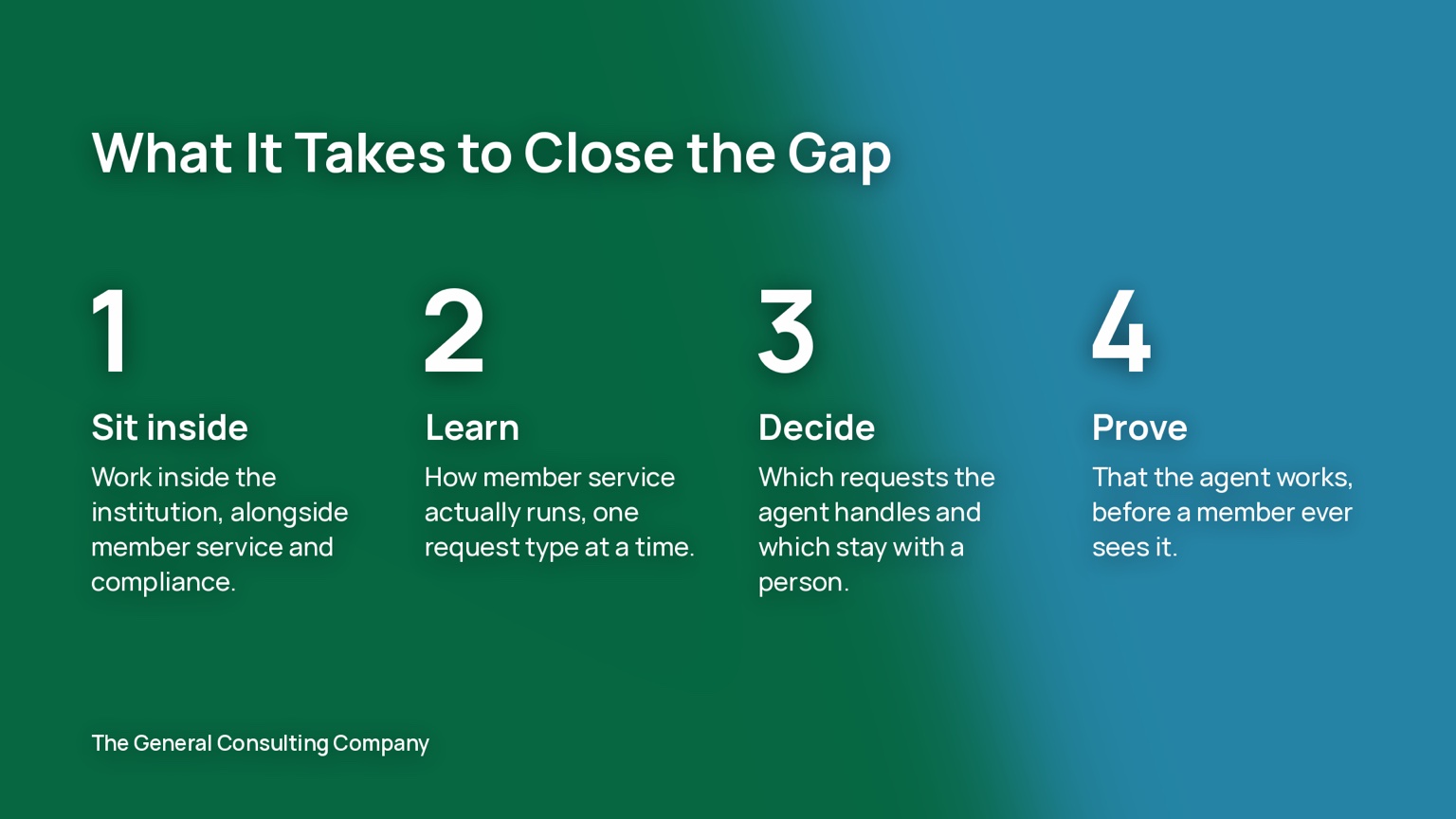
The distance between the two is a deployment problem. Someone has to sit inside the institution, learn how member service actually runs, decide which requests AI should handle and which should stay with a person, and prove the agent works before a member ever sees it.
At a credit union, a wrong answer about a payment, a limit or an account is a compliance event, and the institution answers for it. That is why so much vendor AI stalls after the policy is approved. The board can approve a principle. Nobody can show the compliance team what the agent will and will not do, or prove afterward what it did.
Why Aide
Aide’s Agent Governance Engine puts the member experience team in control of what the agent does. The agent acts only on request types it has been authorized for, only when it is certain, and it hands everything else to a person. Every action is tested before deployment and logged afterward, so compliance can see what the agent did, why, and what happened next. Aide is SOC 2 Type II certified, and it reports 76 percent or higher automated resolution across its live customer accounts.
That matters to us because of how we work. We embed engineers inside the institution and leave the capability with the institution’s own team. An agent the compliance team can inspect and the service team can control is the version of member-facing AI that fits that model.
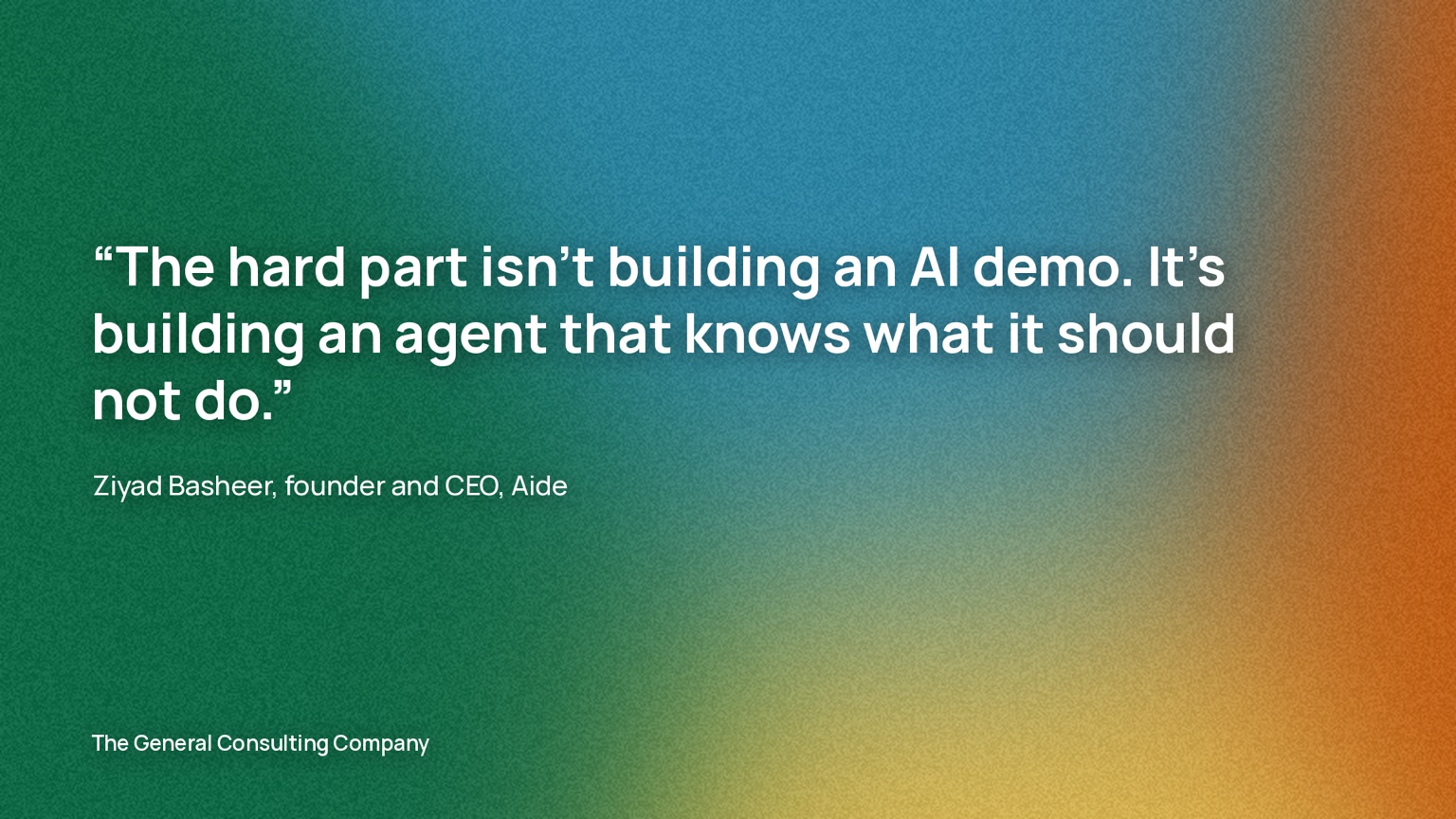
Ziyad Basheer, Aide’s founder and CEO, put it this way in the announcement: “The hard part isn’t building an AI demo. It’s building an agent that knows what it should not do.”
What an Engagement Looks Like
A small team from The GCC starts inside the institution, working with the people who lead member service, the compliance team, and whoever runs the core banking and CRM systems.
With Aide, we map every reason members reach out. Then we go through them one request type at a time and decide which of three things happens: the agent resolves it on its own, the agent drafts a response for a person to review, or the request stays fully human.
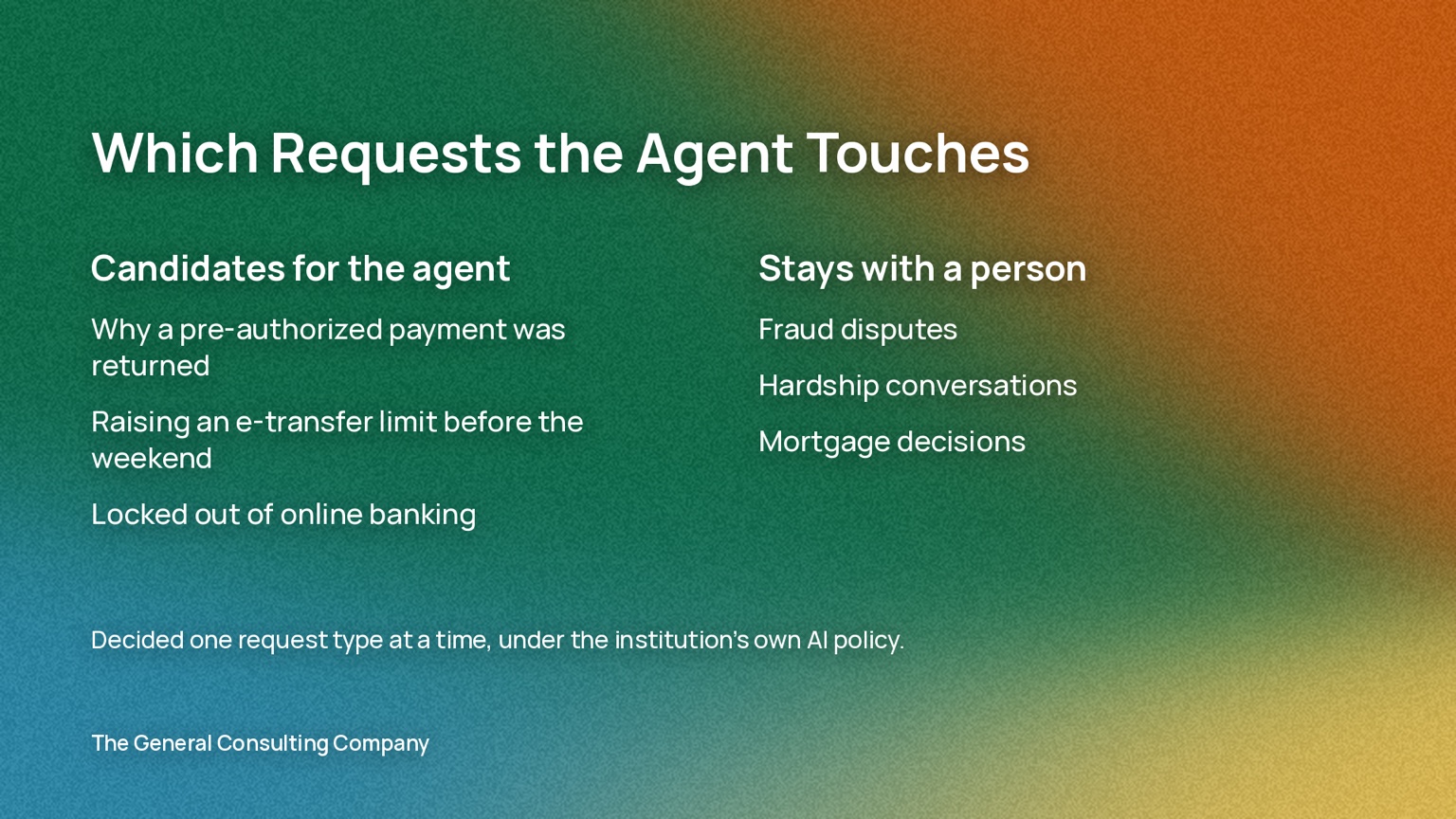
Take a credit union whose service team handles a few thousand emails and chats a month. A member asks why a pre-authorized payment was returned. Another wants an e-transfer limit raised before the weekend. A third is locked out of online banking. These requests are predictable, the answers live in systems the credit union already has, and each one follows a written procedure. They are candidates for the agent.
Fraud disputes, hardship conversations and mortgage decisions stay with the people who should be having them.
The go-live is gradual. The first Scenarios cover a handful of request types, the team watches the results, and new request types are added only after the earlier ones have proved out. We stay embedded through that expansion. The institution’s team sees every decision, sets the confidence bar the agent has to clear, and decides what gets added next.
Governance First
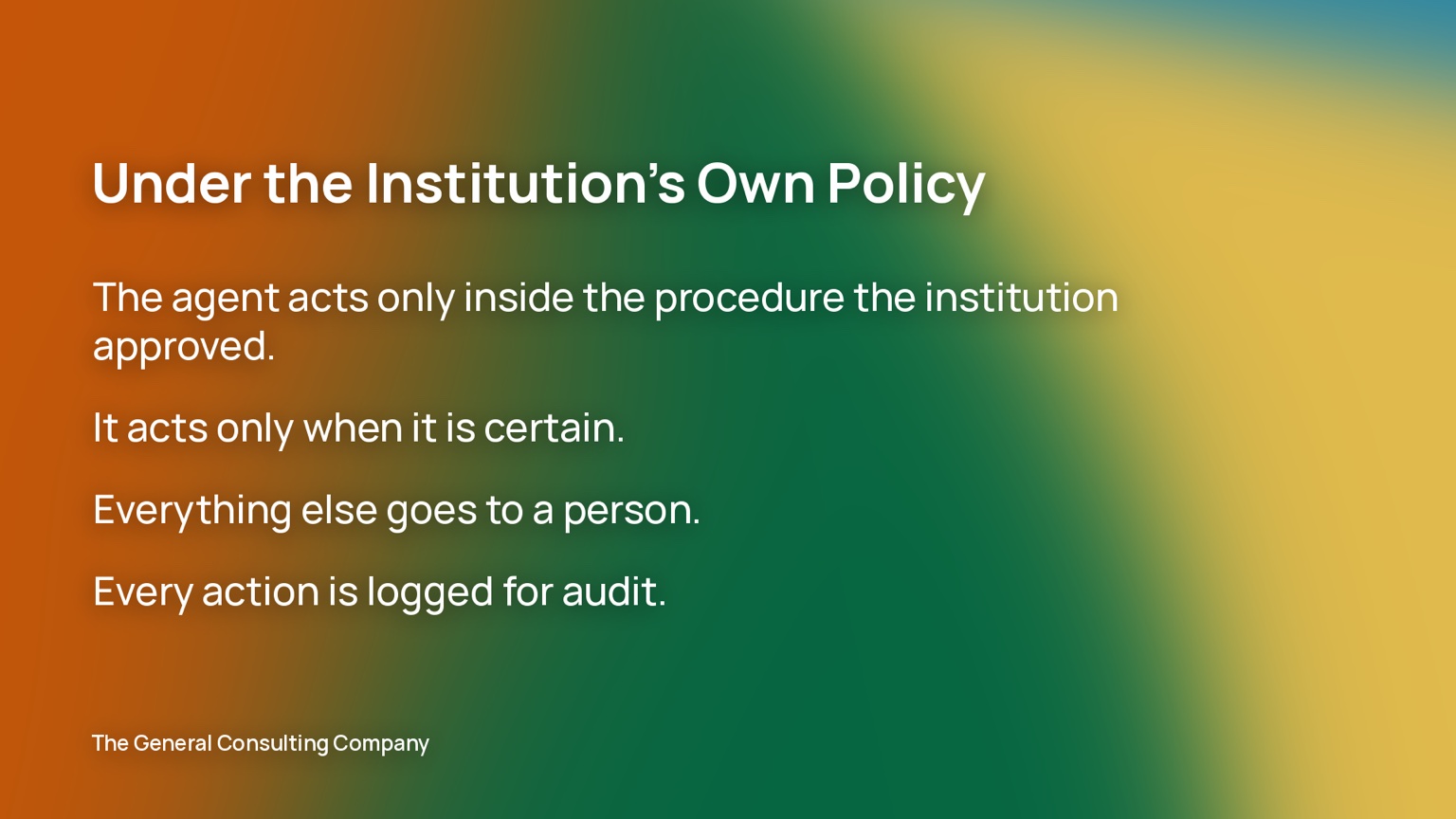
Everything runs under the credit union’s own AI policy. The agent acts inside the procedure the institution approved, only when it is certain, and everything else goes to a person. Anything that needs judgment, and anything that carries compliance risk, stays human by design.
Every action is logged, so the compliance team and the regulator can see what the agent did and why. This is the part that turns a board-approved policy into something an audit committee can check.
How This Fits What We Already Do
Earlier this year we wrote about where AI belongs in the contact centre and where it doesn’t. The short version: wait times, stretched teams and unresolved requests are what erode the member relationship, and a wrong answer belongs on that list too.
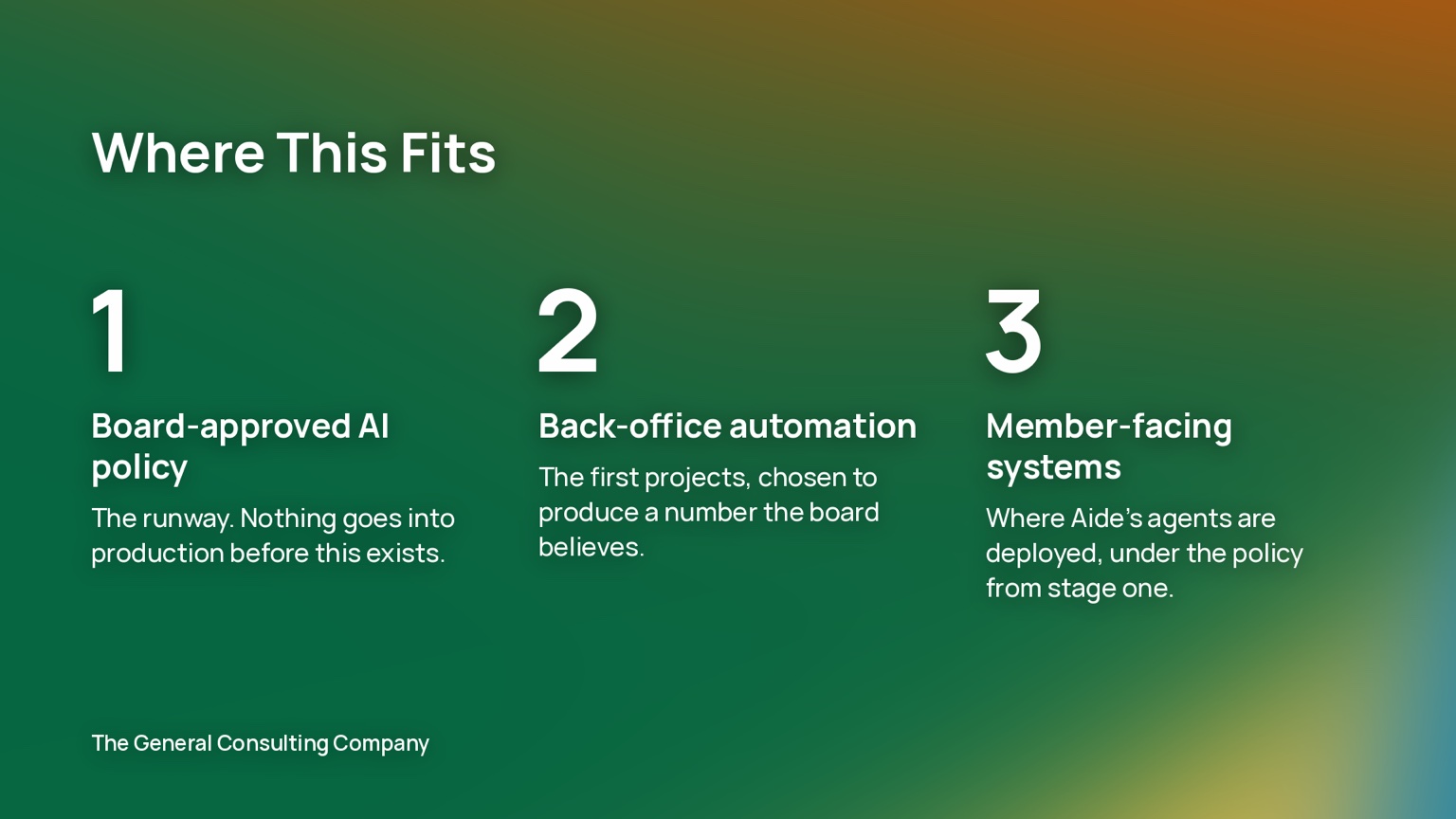
This partnership is how we act on that. Our work with credit unions starts with a board-approved AI policy and moves through back-office automation into member-facing systems. Aide gives us a member-facing agent we can deploy under the policy the board already approved, with the guardrails made explicit one request type at a time.
Next Steps
If you run member experience, operations or compliance at a Canadian credit union or regional bank and want to see what this looks like against your own request volume, book a call with us. To see Aide’s platform directly, you can request a demo at aide.app.
About The General Consulting Company
The General Consulting Company is an AI engineering practice working exclusively with Canadian credit unions. We embed with your team to take you from an AI policy your board will approve through to AI systems running in production across Finance, Compliance, Wealth, and Operations.
Not sure where to start? Book a 30-minute call and we will walk through where your board is on AI, what is consuming your back office, and which stage of AI deployment makes sense first.
BOOK A CALL